
Peter’s Faith Tested Lessons from Jesus Walking on the Sea
The story of Jesus walking on the sea and Peter’s attempt to join Him is one of those passages that has fascinated readers for centuries. It appears in Matthew 14:22–33, with echoes in Mark 6:45–52 and John 6:16–21. On the surface, it is a miraculous moment, but beneath that, it offers a vivid glimpse into how faith works, how fear can shake that faith, and how Jesus responds when we find ourselves struggling.

Struggling in the Storm
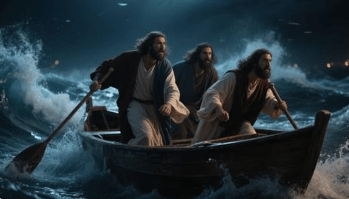
The backdrop of this story matters more than we often notice. It comes immediately after Jesus feeds the five thousand. That moment was spectacular, miraculous, and clearly a demonstration of God’s power. Yet almost immediately, the disciples are sent ahead of Jesus in a boat across the Sea of Galilee. He retreats to pray alone on a mountainside. By evening, the boat is far from shore, tossed by waves and wind. Mark’s account notes that Jesus saw them “straining at the oars,” suggesting that He was aware of their exhaustion long before they called for help. There is a subtle but powerful message here: even when we feel alone, ignored, or distant from God, He is aware of our struggles.
The disciples’ battle with the storm continues for hours. Jesus appears during what the Bible calls the fourth watch of the night, somewhere between three and six in the morning. That timing may seem inconvenient or even frustrating, but it carries its own lesson. God’s help often arrives according to His schedule, not ours. His timing may feel late to us, yet it is always perfect for what He intends to accomplish.
Seeing Beyond the Natural
Then comes the moment that has captured imaginations for centuries. Jesus walks across the water toward them. The act itself is miraculous, but it also serves as a revelation of His divine identity. In Scripture, treading on water is a sign reserved for God alone. There is a curious note in Mark that Jesus “would have passed by them.” In biblical language, a “passing by” often signals a moment of divine revelation, as seen with Moses and Elijah. It suggests that God’s presence is not merely about solving problems; it is also about inviting us to recognize Him more fully.
Yet fear clouds perception. The disciples mistake Jesus for a ghost, their minds struggling to make sense of what they see. Fear has a way of distorting reality. When life feels chaotic, we often misinterpret God’s movements or fail to notice His presence. Jesus’ words cut through their panic: “Take courage! It is I. Don’t be afraid.” The phrase “It is I” in Greek is “ego eimi,” the same name God used when revealing Himself to Moses. Courage is not in the absence of danger but in the assurance that God is present.
Stepping Out in Faith
Peter’s response is almost reckless in its boldness. “Lord, if it’s you, tell me to come to you on the water.” Peter isn’t asking for comfort; he wants closeness with Jesus, even if it means stepping into something that seems impossible. It’s a raw picture of faith: moving forward without guarantees, simply trusting the one who calls. “If you want deeper guidance on building unshakable faith, my ebook 7 Days of Unshakable Faith: A Devotional to Strengthen Your Spiritual Walk”
Jesus’ answer is one word: “Come.” There is no detailed plan, no explanation of how Peter would manage to walk on water. The invitation is simple. Stepping out of the boat, Peter begins to walk toward Jesus. At that moment, the miracle isn’t just a display of power; it is a demonstration of what happens when human obedience meets divine enablement. The boat, the storm, and even common sense are set aside when faith takes the lead.
The Danger of Distraction
But the story shifts quickly. Matthew notes that when Peter noticed the wind and waves, he began to sink. This shift is where the lesson deepens. Peter’s initial courage was grounded in focus—on Jesus. As soon as attention drifted to the storm, fear replaced faith. It is a lesson that still resonates. Our focus shapes our reality. When we magnify problems and shrink the presence of God in our minds, we falter. Even the most courageous faith can falter if it is distracted.
Peter’s response in the midst of sinking is instructive. He cries out, “Lord, save me!” He doesn’t try to swim back on his own, nor does he hide his fear. In moments of crisis, pride often keeps people from immediately asking for help. This story suggests that humility and immediate dependence on God are key to rescue. Calling out is not a sign of weakness but of wisdom.
The Hand of Grace
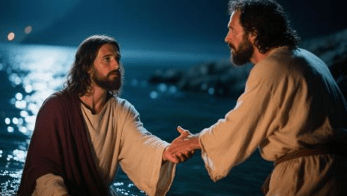
Jesus’ response is immediate. He reaches out and catches Peter. It is an image of grace in action. Peter’s faith was faltering, yet Jesus’ power and care did not waver. There is also a gentle rebuke: “You of little faith, why did you doubt?” This is instructive rather than punitive. Faith can be uneven, fragile, or fleeting, yet even a wavering faith is enough for Jesus to act. His strength meets human weakness.
Once back in the boat, the wind dies down. The calm is not instantaneous when we are in trouble; sometimes it comes after we are brought to a place of safety. The disciples, witnessing this, worship Jesus. Their response is more than awe; it is a declaration of belief. They had seen miracles before, yet now they experienced the combination of divine power and personal rescue.
Lessons for Everyday Life
This story offers several insights for today. First, Jesus sees our struggles long before we call to Him. Feeling abandoned does not mean we are forgotten. Second, His timing is perfect, even when it feels delayed. Storms, as terrifying as they may be, often reveal truths about God’s nature, much like they revealed Jesus’ identity to His disciples.
Fear is a recurring theme. It clouds judgment, distorts perception, and shakes faith. Yet courage comes not from avoiding fear but from recognizing the presence of God amid danger. Peter’s willingness to step out illustrates that faith often asks us to leave comfort behind and enter uncertainty. The call to “come” may seem risky, yet it is precisely in those moments that God’s power becomes apparent.
When we falter, we are reminded to cry out immediately. Pride may tempt us to struggle alone, but the story underscores that rescue comes when we turn to Jesus in humility. The narrative also suggests that our encounters with God rarely leave us unchanged. Worship, gratitude, and renewed belief often follow personal experiences of rescue and divine intervention.
The story is not just an ancient miracle; it functions as a parable for life’s storms. It teaches that our focus determines our faith, that fear can derail us, and that God’s presence is both sufficient and necessary. The waves may rage, the wind may howl, and circumstances may appear hopeless, yet Jesus is not distant. He walks toward us, even on turbulent waters, and His hand reaches for us when we cry out.
Perhaps the most striking lesson is the combination of invitation and presence. Jesus calls us to step out of the familiar, yet He does not abandon us once we take the risk. Faith is not a solitary exercise; it is relational. Our courage is fueled by His presence, our rescue is fueled by His power, and our growth is shaped by our trust.
Even now, in daily life, the story has relevance. When responsibilities pile up, when relationships strain, or when unexpected challenges arise, it is easy to feel adrift. Yet this passage encourages us to notice that God is aware, that His timing is reliable, and that He invites us to move forward even in the midst of uncertainty. And when fear or doubt sets in, calling on Him remains the wisest response.
The final takeaway may be the simplest yet most profound: the One who walks on the waves holds us steady. Our faith may falter, our courage may waver, and our vision may blur, yet Jesus’ hand is always there to catch us. The story of walking on the water and sinking is not just a lesson in miracles; it is a lesson in trust, focus, courage, and the inexhaustible grace of God. Life’s storms may not end immediately, but the One who commands the wind and waves can meet us right in the middle of them.